Concrete Producers: Don’t Be Fooled by "Cloud-Based" Dispatch Claims

Director of Marketing
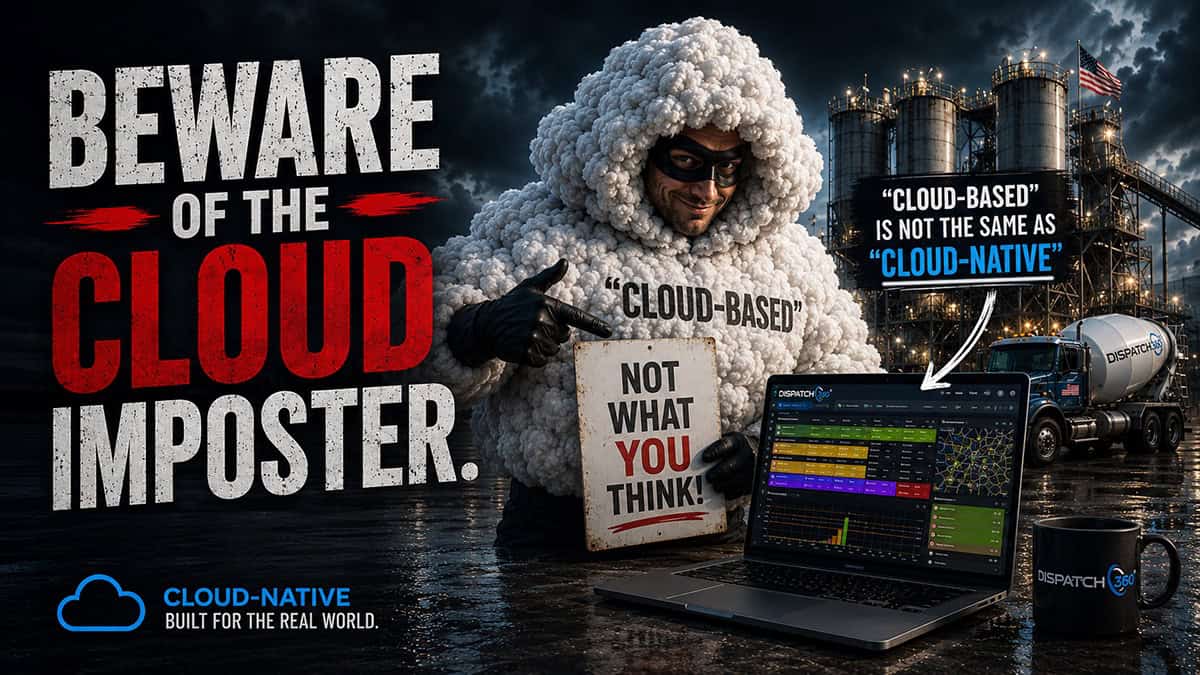
"Cloud-based" and "cloud-native" aren't the same thing. Here's the difference — and why it matters more than most concrete producers realize.
There's a difference between cloud-based and cloud-native — and right now it's the single most important distinction concrete producers need to understand before signing a dispatch software contract.
Producers are being pitched "cloud-based" dispatch from every direction. The label is everywhere. But a growing number of platforms wearing it have simply been lifted off plant servers, dropped onto hosted infrastructure, and re-introduced to the market with new branding. The data center changed. The architecture did not. The result is the same slow upgrade cycles, fragile integrations, and performance ceilings producers were trying to escape in the first place.
The vendors who understand this difference — and built for it from day one — are about to pull away from the rest of the market. Not just on dispatch performance today, but on everything coming next.
Cloud-Based vs. Cloud-Native: The Architectural Distinction That Matters
Cloud-based means the software runs in the cloud. That's it. A legacy dispatch system that used to live on a plant server can be "cloud-based" the moment someone moves it to AWS or Azure. The architecture underneath hasn't changed — it's still a monolithic application originally designed to run on a single machine, just now running on a rented one.
Cloud-native means the software was designed for the cloud from day one. Instead of one large monolithic application, it's built on modern cloud services that scale automatically with demand, handle near real-time data from trucks and plants, and roll out updates frequently without taking dispatchers offline. The architecture is engineered around availability, resilience, and elastic performance — so peak-pour mornings, complex routing scenarios, and last-minute schedule changes don't drag the system down.
That distinction isn't a technicality. It determines how fast your platform can move, how reliably it handles volume, how cleanly it integrates with other tools, and — critically — what it can support next. More on that last part in a moment.
How to Spot a "Cloud-Washed" Dispatch System
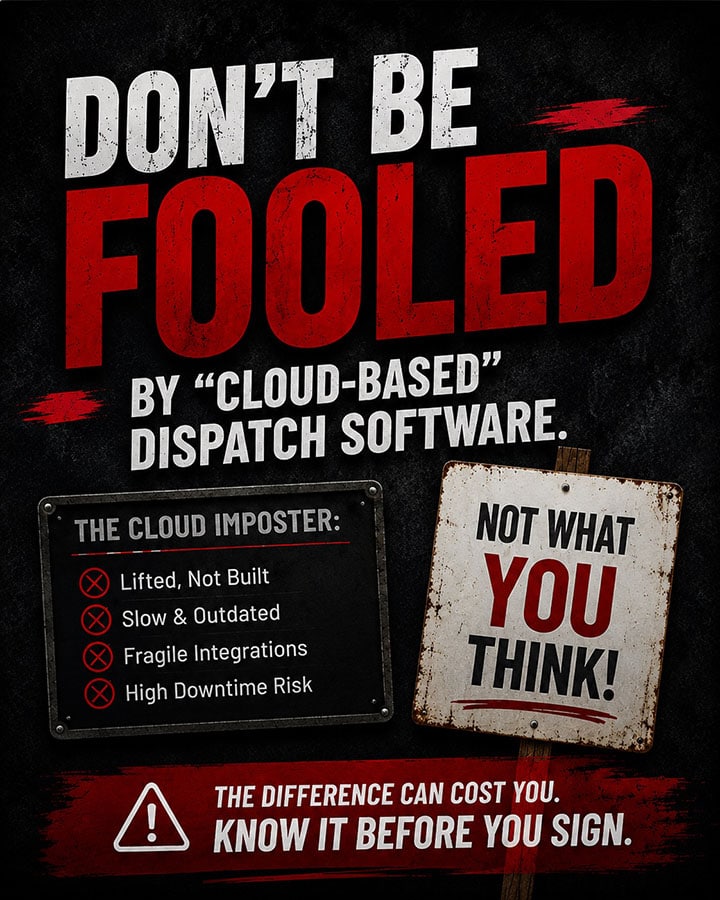
The fastest way to test a vendor's cloud claims is to ask one question: "Was this product originally built as on-premise software?" If the answer is yes — even if they pivot quickly to talking about their hosted version — you're almost certainly looking at a lift-and-shift system rather than a true cloud-native platform. These systems may now run in someone else's data center, but they typically carry forward the same monolithic codebase, batch processing patterns, and slow upgrade cadence that made them painful on-premise.
A second tell is the patchwork stack. Ask whether dispatch, ticketing, fleet tracking, and the customer portal were all developed together — or whether they were acquired separately and stitched into a "platform." When modules sit on different databases or codebases, you get brittle integrations, inconsistent user experiences, and long resolution times when something breaks, because no single engineering team fully owns the system end-to-end.
A third tell is deployment cadence. Cloud-native teams release small, frequent improvements — sometimes weekly. Cloud-washed products tend to ship large, high-risk upgrades two or three times a year, because the architecture can't support anything faster.
What a Real Cloud-Native Dispatch Platform Delivers
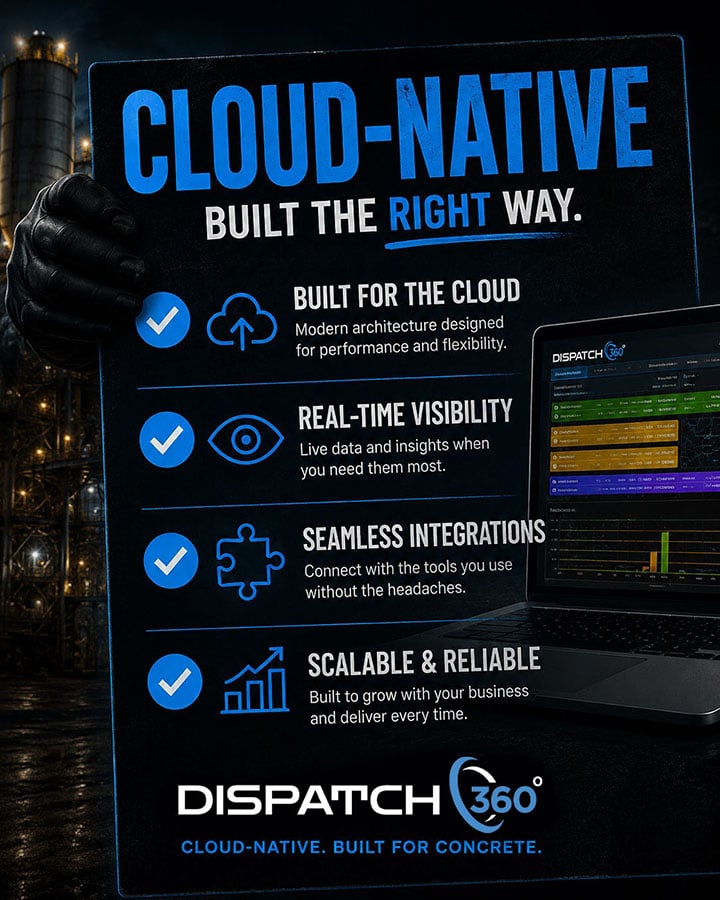
A genuine cloud-native dispatch platform delivers three things producers can measure: speed, visibility, and reliability.
Speed shows up as near real-time GPS and telematics — dispatchers see live truck locations, statuses, and pour windows on a map, not in delayed batch updates. That visibility is the difference between catching a delay before the customer calls and explaining it after they do.
Visibility extends to integration. A modern platform connects to your batching system, your telematics provider, your customer-facing tools, and your back-office stack through documented APIs — not nightly file drops and custom-coded scripts that break every time someone pushes an update.
Reliability comes from architecture and culture together. A single, well-architected platform owned end-to-end by one engineering team means issues get diagnosed and fixed quickly, and new features arrive without disrupting operations. That's a meaningfully different experience from a vendor whose "platform" is actually four acquired products held together with middleware.
Cloud-Native at Scale: What Dispatch360 Looks Like Under the Hood
One way to see cloud-native architecture in practice is to look at the infrastructure layer. Dispatch360 and its sister platform skEYEvue — both built by skEYEwatch — run on Oracle Cloud Infrastructure — and the move there wasn't a marketing decision. It was the result of running into the limits of a different major cloud provider and choosing to migrate.
According to Oracle's published case study on skEYEwatch, skEYEwatch migrated its entire SaaS application suite off AWS DocumentDB and onto OCI with Oracle Autonomous JSON Database. The documented results:
- 74% — Reduction in monthly cloud invoice
- 48% — Increase in transaction growth handled simultaneously
- 60% — Reduction in database administration workload
- 1 month — Migration completed vs. 4-month projection, zero disruption
The platform now supports 21,000 vehicles and processes 15 billion daily data events, with data refreshed every five seconds.
Here's the part worth pausing on: this isn't a story about migrating from on-premise to the cloud. It's a story about migrating from one cloud to a better-architected cloud — the kind of decision only a company already operating natively in the cloud can make. A lift-and-shift platform doesn't have that option. It's locked into whatever infrastructure it was dropped onto, because the architecture underneath was never designed to be portable, scalable, or modular in the first place.
That architectural difference shows up in every aspect of how Dispatch360 operates today — speed, reliability, integration, support. But it shows up most dramatically in what cloud-native architecture is built to support next.
WHY THIS MATTERS MORE THAN MOST PRODUCERS REALIZE
Cloud-native isn't just a better foundation for dispatch today. It's the only architecture that can support what's coming.
The next wave of competitive advantage in concrete dispatch isn't going to come from better screens or faster ticket entry. It's going to come from AI-driven optimization — continuous, mathematical re-planning of schedules based on real-time conditions. More loads per truck. Fewer empty miles. Smaller fleets delivering the same volume. Lower logistics unit costs.
And here's the part most vendors won't tell you: real AI optimization can't run on legacy architecture. It requires clean, current, structured, high-volume data flowing continuously between the dispatch system and the optimization engine. That's exactly what cloud-native platforms are built to handle — and exactly what cloud-washed platforms struggle with.
That's why Dispatch360 was built cloud-native from day one. Not because "cloud" was a marketing trend, but because we knew the architectural decision we made on day one would determine what we could support on day 1,000. And the AI conversation is where that decision pays off the most.
COMING NEXT · ARTICLE 2 · THURSDAY, MAY 29
Concrete Producers: Don't Be Fooled by "AI-Powered" Dispatch Claims
We'll break down what real AI in concrete dispatch actually looks like, who's leading the space, and why most "AI-powered" pitches on the market right now are running into a ceiling they can't get past. Stay tuned.
In the meantime, if you're evaluating dispatch software — or already evaluating a "cloud" platform that started its life somewhere else — that's a conversation worth having before you sign the next renewal.
Frequently Asked Questions
What is the difference between cloud-based and cloud-native dispatch software?
Cloud-based dispatch software simply means the software runs in the cloud — even legacy on-premise platforms can technically be called cloud-based once moved to hosted infrastructure. Cloud-native dispatch software was designed for the cloud from day one, built on modern services that scale automatically, handle near real-time data, and update frequently without disruption. The architectural difference determines speed, reliability, integration quality, and what the platform can support next.
How can I tell if a dispatch software vendor is truly cloud-native?
Ask one question: was this product originally built as on-premise software? If the answer is yes, it's almost certainly a lift-and-shift system rather than a true cloud-native platform. Two other tells: ask whether the modules (dispatch, ticketing, fleet tracking, customer portal) were developed together or acquired separately, and ask how often they release updates. Cloud-native teams release small improvements frequently; cloud-washed products ship large risky upgrades two or three times a year.
Why does cloud-native architecture matter for concrete dispatch software?
Cloud-native architecture determines how fast a dispatch platform can handle peak-pour mornings, how reliably it integrates with batching systems and telematics, how often the vendor can ship improvements, and what new capabilities the platform can support. Most importantly, cloud-native architecture is the foundation that AI optimization requires — real AI in dispatch needs clean, current, structured data flowing continuously, which legacy lift-and-shift platforms struggle to provide.
What questions should I ask a dispatch software vendor about their cloud architecture?
Ask four questions. First, was the product originally built as on-premise software? Second, were the modules — dispatch, ticketing, fleet tracking, customer portal — developed together or acquired separately? Third, how often do you release updates? Fourth, who owns the platform end-to-end from an engineering standpoint? The answers will tell you whether you're looking at a true cloud-native platform or a cloud-washed legacy system.
What cloud infrastructure does Dispatch360 run on?
Dispatch360 and its sister platform skEYEvue — both built by skEYEwatch — run on Oracle Cloud Infrastructure, using Oracle Autonomous JSON Database. According to Oracle's published case study, the migration to OCI reduced monthly cloud costs by 74%, supported a 48% increase in transaction growth, reduced database administration workload by 60%, and was completed in one month versus a projected four-month timeline. The platform now supports 21,000 vehicles and processes 15 billion daily data events with data refreshed every five seconds.
Director of Marketing
James Harris leads marketing for Dispatch360 and has spent years embedded in the ready-mix concrete, aggregate, and construction materials industry — learning the operational realities that dispatchers, plant managers, and fleet operators deal with every day. He authors The Dispatch Journal, where he covers dispatch te…
Ready to See Dispatch360 in Action?
The best way to understand what Dispatch360 looks like for your operation is to see the actual platform running.