Don't Be Fooled by "AI-Powered" Dispatch Software

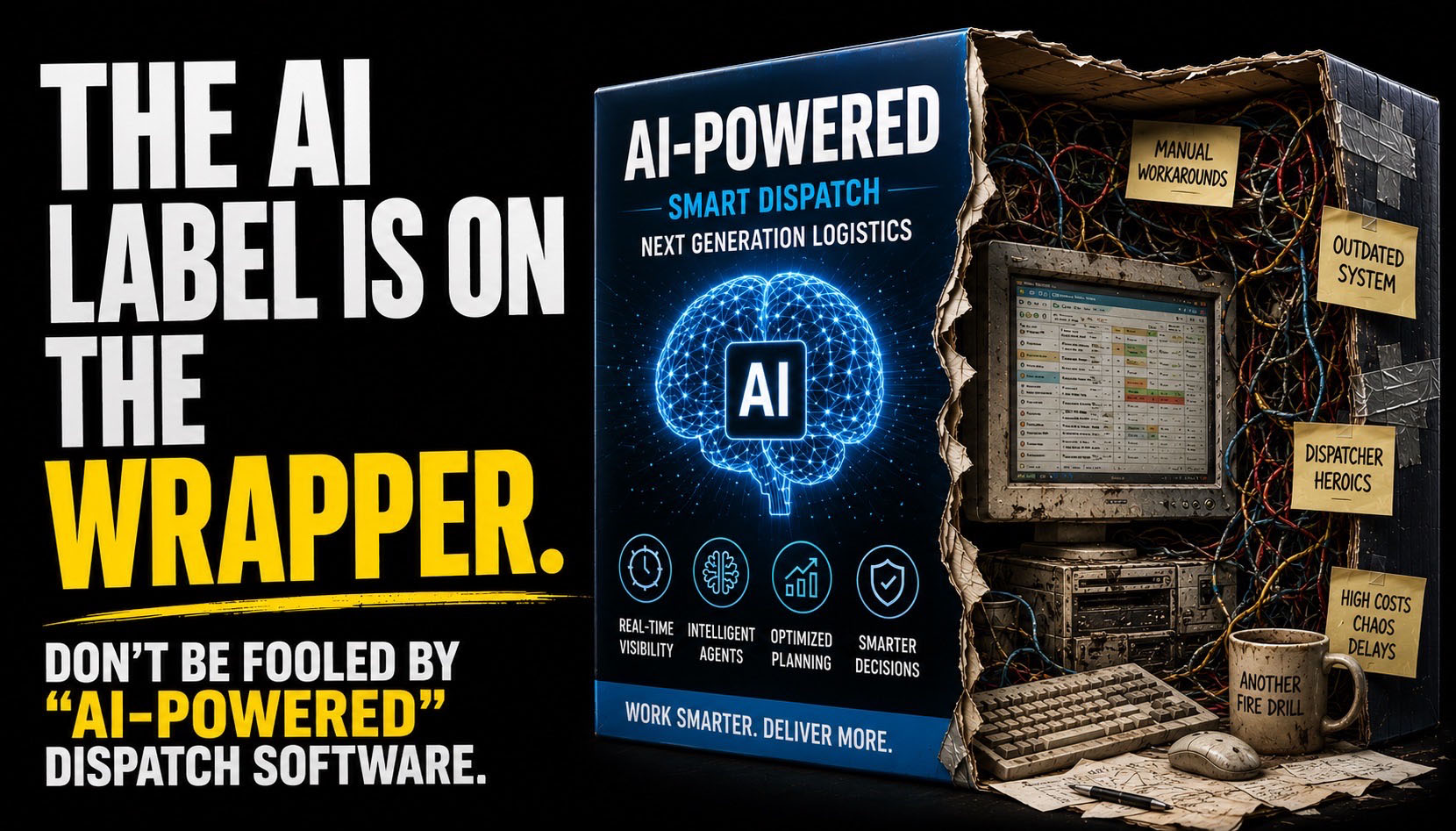
"AI-powered" is the new "cloud-based." Here's how to tell whether a dispatch platform is genuinely intelligent — or just rebranded.
Not long ago, "cloud-based" was the software buzzword everywhere. Now a new label is taking over: "AI-powered."
For dispatch buyers, that should not be exciting by default. It should raise a question: what is the AI actually doing?
Because in a growing number of cases, "AI-powered" sounds a lot more advanced than it really is. A chatbot gets added to the screen. A few canned prompts appear in a demo. A basic rules engine gets wrapped in new language. Suddenly, the platform is being marketed as intelligent.
That does not necessarily mean the software is solving harder dispatch problems. It may just mean the marketing caught up with the trend.
The New Buzzword Problem
This is what makes the current moment feel familiar.
In the same way many vendors used "cloud-based" as a broad label without fully rethinking the software underneath, some are now using "AI-powered" in ways that sound bigger than the actual capability. Recent write-ups on AI-washing, deceptive AI claims, and overhyped artificial intelligence all point to the same issue: some vendors are using AI language much faster than they are delivering real AI capability.
That matters in dispatch because this industry does not need AI for the sake of AI. It needs better decisions. It needs less chaos. It needs faster responses to changes in the field. If the software cannot improve real operational outcomes, then the label does not mean much.
A Chatbot Is Not the Same as Smarter Dispatch
One of the easiest ways for software companies to sound modern right now is to add a conversational interface and start talking about agents.
But an "agent" is not automatically intelligence in the operational sense buyers care about.
Some vendors are now branding conversational interfaces as "agents" and presenting them as proof the platform is AI-driven, even when the underlying workflows have not fundamentally changed.
In practice, that often looks like a branded assistant that can answer questions, summarize data, and help users navigate the interface, while leaving the actual dispatch decisions exactly where they were. The dispatcher is still doing the same work. The plan is still built the same way. The AI label is on the wrapper, not the engine.
That can still be useful. But it is not the same as software that is optimizing schedules, improving truck utilization, predicting conflicts, or helping dispatch teams make better decisions under pressure.
Those are very different levels of capability.
The problem is not that chatbots are bad. The problem is when a chatbot is presented as if it proves the platform itself is deeply AI-driven.
What Real AI in Dispatch Should Actually Do
Real AI in dispatch should show up in operational performance.
It should help teams make better decisions faster. It should reduce manual guesswork. It should improve scheduling quality when conditions change. It should help dispatchers respond to exceptions without relying on experience alone or last-minute heroics.
That is the standard companies should use when they hear the phrase "AI-powered dispatch." The important question is not whether the software has a conversational interface. The important question is whether it improves the actual math and decision-making behind dispatch.
That is why AI-powered transport planning and building materials logistics optimization are better benchmarks than a chatbot demo. INFORM's work in ready-mix concrete, cement, aggregates, and asphalt logistics is centered on solving operational complexity, not just making the interface sound more current. Independent coverage of AI optimization in building materials logistics points to the same theme: the real value is in optimization, utilization, and decision quality.
Thomas Bergmans, SVP Logistics at INFORM, has noted that legacy dispatch software tends to lock operations into the same patterns instead of helping them improve. His broader point is an important one: if older systems were designed mainly to record transactions, but not to capture operational reality, then they also struggle to optimize what actually happens in the field. The result is often familiar to producers: manual workarounds, dispatcher heroics, avoidable empty miles, underutilized assets, and logistics costs that remain structurally higher than they need to be.
That is what makes real AI different from AI theater. Real AI needs access to real operational signals. It needs current data. It needs workflows that reflect what the business is actually doing. Otherwise, the software may be dressed up with AI language while the operation underneath stays largely the same.
Signs the "AI-Powered" Claim May Be Thin
Some warning signs are becoming easier to spot. Outside guidance on AI marketing exaggeration, inflated AI capabilities, and false advertising around AI all point to the same red flags: vague language, no measurable outcomes, and an inability to explain what the technology is actually doing.
In dispatch software, that often looks like:
- The vendor talks a lot about AI, but cannot explain what decisions it improves.
- The "AI" mostly appears as a chatbot, assistant, or prompt box.
- There are no measurable operational outcomes behind the claim.
- Dispatchers still do the same manual work they did before.
- The workflows, recommendations, and planning logic do not appear meaningfully different from legacy software.
These are the same kinds of gaps buyers have learned to watch for with cloudwashing. The label may be new, but the pattern is familiar: the market wants the buzzword, so vendors adapt the language faster than they adapt the product.
Why This Matters in Concrete Dispatch
Concrete dispatch is not a simple environment. It is time-sensitive, operationally dense, and constantly changing.
Plants, trucks, traffic, jobsite delays, driver availability, order changes, mix designs, water added at the job, weather forecasts, reporting requirements, and tight delivery windows all put constant pressure on the system. In that environment, real AI should not be judged by how futuristic it sounds, but by how reliably it helps the operation stay a step ahead of what is happening on the ground.
That is why concrete producers should be skeptical of vague AI claims. A flashy assistant may be interesting. But if the platform still depends on manual workarounds, tribal dispatcher knowledge, and reactive decision-making, then the AI layer may be more cosmetic than transformational.
This is also why architecture still matters. AI can only optimize what the platform can reliably capture, structure, and respond to. When the underlying construction materials dispatch software is rigid, fragmented, or heavily dependent on manual intervention, the ceiling on AI value is lower no matter how strong the marketing language may be.
Better Questions to Ask Vendors
As buyers evaluate "AI-powered" dispatch software, a few simple questions can cut through the noise.
- What specific dispatch decisions does the AI improve?
- Is it making predictions, recommendations, optimizations, or just answering questions?
- What data is it using?
- Can the vendor show measurable outcomes from actual customers?
- Does the AI improve planning quality, truck utilization, service levels, or response time?
- How does it behave when real-world conditions change during the day?
These questions matter because real AI should be visible in the operation, not just in the pitch.
They also tend to reveal whether a vendor built a real platform or just added modern language on top of old software. That is the same logic behind evaluating cloud-native concrete dispatch software, enterprise ready-mix dispatch software, and any platform claiming to be built for long-term operational growth.
What Real AI Looks Like at Dispatch360
The future of AI in concrete dispatch isn't a chatbot. It's a platform that helps producers make better decisions before problems show up at the plant. Better truck utilization. Better routing in changing conditions. Earlier visibility into operational bottlenecks before they cost a pour. That's where AI creates real value in dispatch — and that's the standard Dispatch360 is being built against.
Getting there starts at the data layer. AI is only as good as the operational reality the platform underneath it can capture, structure, and feed into the engines that make optimization possible.
That's why Dispatch360's data infrastructure runs on Oracle's Autonomous Database family — a platform built to support AI workloads with automated tuning, machine-learning-driven self-management, and the architectural foundation real AI optimization needs to run on top of. The same migration that earned Oracle's published case study on skEYEwatch — the 74% reduction in cloud costs, the 48% increase in transaction growth, the 60% reduction in database administration workload — also moved the platform onto infrastructure that was built for AI from the ground up. Not retrofitted to host it.
That's the foundation. What's coming next is being built on it, and producers will see it soon. We'd rather show the operational outcomes than promise the slide.
And yes — Dispatch360 will be adding a conversational interface at some point too. Producers like chatbots. They're useful for navigation, summarization, and asking quick questions of the system. But to be clear about what that chatbot is and isn't: it will be the convenience layer on top. The AI is in the database, the optimization engine, and the operational decisions the platform actually makes. The chatbot will be a chatbot. The AI will be the AI. That distinction is the whole point of this article.
The Same Lesson, New Buzzword
The lesson is very similar to the one many software buyers are already learning about cloud claims.
"Cloud-based" became so broad that it lost meaning. "AI-powered" is now heading in the same direction. Both phrases can describe genuinely transformative platforms. Both phrases can also be slapped onto legacy software with very little under the hood.
Buyers learned to look past the word "cloud" and ask what the architecture actually does. The same instinct is now needed with AI. The label is not the proof. The outcomes are.
Closing Thought
The next wave of dispatch software marketing is here, and AI is going to be written on nearly everything.
Buyers should not reject AI. But they also should not be impressed by the label alone.
The real question is simple: does the software use intelligence to improve the hard parts of dispatch, or does it just talk about intelligence better than the last platform did?
Because in this market, a chatbot may be helpful. But a chatbot is not the same thing as smarter dispatch.
Director of Marketing
James Harris leads marketing for Dispatch360 and has spent years embedded in the ready-mix concrete, aggregate, and construction materials industry — learning the operational realities that dispatchers, plant managers, and fleet operators deal with every day. He authors The Dispatch Journal, where he covers dispatch te…
Ready to See Dispatch360 in Action?
The best way to understand what Dispatch360 looks like for your operation is to see the actual platform running.